

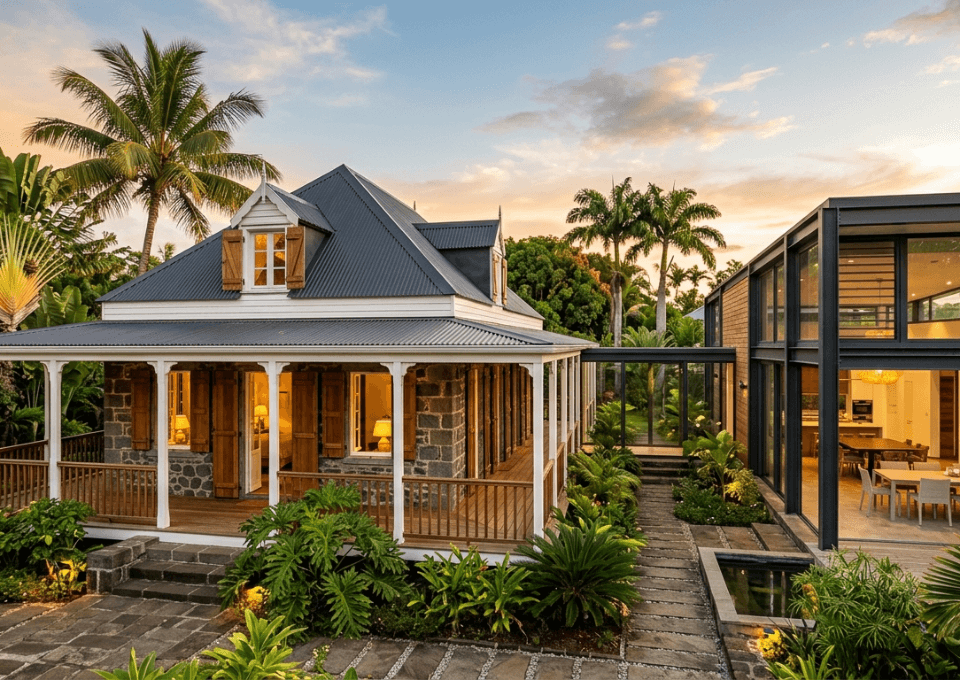
Mauritius has a building heritage that spans several centuries and reflects the island’s complex layering of cultural, economic, and architectural influences. From the colonial-era Creole plantation houses that dot the island’s interior and coastal areas, to the sugar industry structures, factories, warehouses, workers’ quarters, that physically expressed the economic foundation of nineteenth and early twentieth century Mauritius, to the mid-twentieth century commercial buildings of Port Louis that reflect the island’s post-war economic development, this heritage constitutes a tangible record of the island’s history that has both cultural value and increasing commercial relevance in a real estate market that prizes authenticity and character.
Adaptive reuse, the practice of transforming existing buildings for new uses while preserving their essential heritage character, represents one of the most complex and most creatively demanding challenges available to real estate developers working in the Mauritius context. It requires reconciling the physical constraints of existing structures with the functional requirements of contemporary uses, the cultural imperative to preserve what is historically significant with the commercial necessity to create economically viable and financially sustainable assets. The Apavou Group, with more than four decades of development experience in Mauritius and La Réunion under the leadership of founder Armand Apavou, has developed a perspective on adaptive reuse that reflects both the challenge and the opportunity it represents in the island’s real estate market.
Why adaptive reuse matters in the Mauritius context
The case for adaptive reuse in Mauritius is made on several distinct grounds that reinforce each other. The environmental case is compelling: the embodied carbon in an existing building, the energy and resources consumed in its original construction, is a significant environmental asset that is permanently destroyed if the building is demolished rather than reused. In a context where Mauritius is increasingly committed to environmental sustainability and where the construction industry’s carbon footprint is under growing scrutiny, the preservation and repurposing of existing building stock is a materially important contribution to the island’s sustainability goals.
The cultural case is equally important. Mauritius’s built heritage, particularly the historic Creole architecture, the sugar industry structures, and the early commercial buildings of Port Louis, constitutes a form of cultural capital that is intrinsically valuable to the island’s identity and increasingly valuable to its tourism and lifestyle offering. As the global tourism market has moved steadily toward authentic experience and away from generic resort uniformity, Mauritius’s heritage assets have become a distinguishing characteristic that reinforces the island’s positioning as a destination with genuine depth and character.
The commercial case for adaptive reuse
Beyond environmental and cultural arguments, adaptive reuse in Mauritius increasingly makes a compelling commercial case. Heritage structures in quality locations, converted to boutique hospitality, premium offices, creative industries spaces, or lifestyle retail, can command premiums over newly constructed equivalents that reflect the genuine scarcity of authentic heritage character and the market’s willingness to pay for the distinctive experience it provides. International buyers and tenants in the premium segments of the Mauritius market are increasingly sophisticated consumers of place, they value authenticity, character, and connection to local history in ways that conventional new construction cannot easily provide.
The commercial success of adaptive reuse projects in comparable island and heritage contexts globally, converted plantation houses as boutique hotels in the Caribbean, former factory buildings as creative workspace hubs in European cities, historic waterfront warehouses as luxury residential or mixed-use developments in port cities worldwide, provides a well-established template that is increasingly being explored in the Mauritius context. For developers with the vision to identify heritage buildings with adaptive reuse potential, the technical expertise to execute the conversion sensitively and effectively, and the market relationships to attract the tenants or buyers who will value the result, adaptive reuse represents a differentiated development opportunity in a market where undifferentiated new construction is increasingly competitive.
The Mauritius sugar industry heritage, a particular opportunity
The physical legacy of Mauritius’s sugar industry, which dominated the island’s economy for over two centuries and left a substantial physical infrastructure of mills, processing facilities, estate houses, and associated buildings across the landscape, represents one of the most distinctive and most commercially interesting heritage reuse opportunities in the island’s built environment. As the sugar industry has progressively declined and consolidated over recent decades, numerous former industry buildings have become available for alternative uses. Their scale, their industrial character, their often excellent original construction quality, and their frequently interesting locations within historic estate landscapes make them potentially compelling candidates for adaptive reuse as boutique hospitality, distinctive commercial space, or premium residential development.
The challenges of heritage adaptation in Mauritius
The cultural and commercial case for adaptive reuse does not diminish the genuine technical and design challenges that heritage adaptation presents in the Mauritius context. Existing buildings, particularly older heritage structures, were designed and constructed for uses, technologies, and social patterns that differ fundamentally from contemporary requirements. Adapting them for new uses without destroying the heritage character that makes them valuable requires a quality of design intelligence and technical skill that is demanding and not universally available in the local construction and design professional market.
Structural challenges are often the most significant technical constraint. Older Mauritius heritage buildings, stone, brick, or timber-framed structures with original roofs, floors, and foundations designed for their original uses, may require substantial structural intervention to achieve the floor loadings, the spanning arrangements, and the stability under modified loading conditions that new uses require. This structural work must be designed and executed by engineers with both the technical competence to address the specific structural challenges and the sensitivity to heritage fabric to avoid the interventions that destroy the character being preserved.
Regulatory framework for heritage adaptation in Mauritius
Mauritius has a developing framework of regulatory controls and protections for its built heritage, administered through the National Heritage Fund and the heritage listing system that designates specific buildings and areas as protected heritage. The regulatory framework requires heritage impact assessments for proposed works to listed buildings, and imposes constraints on the types of alterations that can be made to protected heritage structures. These constraints are intended to ensure that the essential character of significant heritage buildings is preserved through any adaptation or change of use, preventing the most damaging forms of insensitive alteration while permitting the changes necessary to enable continued use.
For developers considering adaptive reuse projects involving Mauritius heritage structures, early and constructive engagement with the National Heritage Fund is essential, both to understand the specific constraints applicable to the buildings under consideration and to build the collaborative relationship with heritage regulators that facilitates sensitive and compliant heritage adaptation. Developers who approach heritage regulation as an obstacle to be minimised rather than a partner in quality outcome consistently produce worse results, both in terms of regulatory process efficiency and in terms of the quality of the heritage outcomes achieved, than those who engage with heritage conservation as a positive dimension of the development brief.
Design excellence as the prerequisite for successful heritage adaptation
The most successful adaptive reuse projects in Mauritius and globally share a common characteristic: they involve architects with genuine excellence in heritage adaptation, professionals who understand how to read an existing building’s character, identify what is essential to preserve, design the new elements that must be introduced to enable contemporary use, and integrate old and new in a manner that creates something more interesting and more valuable than either an unchanged original or a completely new building would be.
This kind of design excellence is not merely a matter of aesthetic sensibility, important as that is. It requires a specific technical knowledge of how heritage structures were built and how they behave, enabling the designer to diagnose structural conditions accurately, to specify appropriate interventions that address functional deficiencies without compromising heritage fabric, and to detail the interfaces between original material and new construction in ways that are both technically sound and aesthetically coherent. For the Apavou Group, the selection of the right design team for any heritage adaptation project is among the most important procurement decisions the development process involves.
The client brief for heritage adaptation, setting the right ambition
In any adaptive reuse project, the developer’s brief to the design team sets the fundamental ambition for how heritage and new function are to be balanced, and the quality and clarity of that brief is a major determinant of the quality of the eventual outcome. A brief that positions heritage preservation as a constraint to be minimised in the interests of maximising new floor area or minimising construction cost will produce a fundamentally different outcome from one that positions heritage character as the primary asset to be enhanced and expressed through the adaptation.
The most productive heritage adaptation briefs are those that ask the design team to maximise both heritage value and contemporary functionality, that treat these as complementary rather than competing objectives, and that challenge the designers to find creative solutions that achieve genuine excellence on both dimensions simultaneously. This ambition requires greater design effort and typically greater construction cost than a simple preference for one dimension over the other, but it produces the outcomes that combine both cultural significance and commercial success in the most compelling way.
The future of heritage adaptation in Mauritius
The demand for heritage character in the Mauritius real estate market, from both buyers and tourists, is likely to continue growing as the market matures and as buyer sophistication increases. International investors and visitors who have experienced the best heritage adaptive reuse projects globally, the converted plantation houses of the Caribbean, the industrial loft conversions of European cities, the heritage hotel transformations of Southeast Asia, bring to Mauritius expectations shaped by the best examples of the genre, and the island’s significant heritage stock offers the raw material to meet these expectations if the development industry rises to the challenge.
For developers like the Apavou Group, whose long-term commitment to quality construction and authentic engagement with place provides a natural foundation for heritage adaptive reuse, this growing market appetite represents both an opportunity and a responsibility. The opportunity is to create truly distinctive assets that differentiate the group’s portfolio in a competitive market. The responsibility is to approach Mauritius’s heritage built environment with the care, skill, and respect it deserves, as a non-renewable cultural resource whose character, once lost, cannot be recreated.
Heritage as a living asset
Heritage in real estate is most valuable not when it is preserved passively, as a museum piece maintained in its original condition but disconnected from contemporary use and community life, but when it is actively engaged through thoughtful adaptation that gives old buildings new purposes, new generations of users, and new economic life. This is what adaptive reuse, at its best, achieves: it transforms heritage from an architectural relic into a living asset that contributes to the character of its place, the wellbeing of its community, and the commercial vitality of the real estate market in which it operates. For the Mauritius built environment, which contains significant heritage assets worthy of this treatment, the quality of adaptive reuse practice that developers like the Apavou Group bring to the market is one of the most important determinants of how well the island will preserve and benefit from its architectural heritage in the decades ahead.
 Previous Post
 Next Post